-
 The three high-school birders, dubbed The Pete Dunnelins, have one day to count as many bird species across the state of New Jersey as physically possible. Here's what it takes.
 -
 It's the first week of sea turtle nesting season in Southwest Florida, and this year the thousands of loggerheads and greens that nest on our beaches have a new ally in nine-year-old entrepreneur Naomi Haynam. The Cape Coral pre-teen so loves sea turtles she's making beach-themed earrings and selling them at home, online, and in parks to raise money to donate to volunteer sea turtle protection groups.
 -
 In the warm sun, gathering handfuls of hard olives promised a taste of home that residents of a village in the Homs countryside had been missing for nearly 14 years of civil war.
 -
 FWC officers are investigating the incident, and they believe the mothballs were placed intentionally to disrupt shorebird nesting.
 -
 The Pulitzer-winning composer, whose unconventional music reflects the rugged landscapes he lives in, talks about his relationship to nature and his new piece Horizon.
 -
 On "Florida Matters Live & Local," Albert Whitted Airport Manager Richard J. Lesniak discusses what electric air taxis could mean for public transportation and more.
 -
 Rio de Janeiro in Brazil is home to the world's largest urban rain forest. Woven among the city's bustling neighborhoods are soaring tree canopies, waterfalls, and miles of hiking trails.
 -
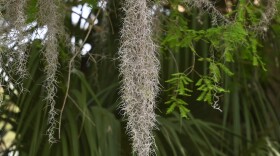 Spanish Moss is familiar to anyone who has visited Florida. It can appear anywhere as a result of the wind dispersing its seeds as it does the seeds of dandelions. But development of the draping clusters of Spanish Moss depends on the seed landing in the right place – on a horizontal limb of a rough-barked tree near water or in a very humid environment. Most Spanish Moss plants only grow to a bit over a foot long, but as they reproduce, one plant becomes many plants linked together by their limb-like scaly-surfaced leaves.There is safety and a future for the plants in such a mass. The cluster of plants holds moisture in – allowing them to survive dry times and also facilitating pollination as insects move from a flower on one plant to a flower on another in the cluster. A mass of Spanish Moss plants appears gray during dry times as the plant shrinks, but is green in appearance as rains allow the plant to swell with water and expose bare areas between the scales.
 -
 You don't need binoculars and a trip to a nature preserve to go bird watching. If you've ever paused to appreciate a bird, you're already well on your way. Here's how to get started.
 -
 The renowned trees along Washington, D.C's Tidal Basin were sent as a gift from Japan in 1912. Some of the original trees are still there.

© 2026 All Rights reserved WUSF

Florida's Classical Music Station
Play Live Radio
Next Up:
0:00
0:00
Available On Air Stations


